


When the first cold mornings arrive in Korea, small tented stalls appear near subway exits and market entrances, smelling of toasted batter and sweet red beans. Koreans even have a slang word, bung-segwon, for living within easy reach of a bungeoppang stall. On October 10, 2026, Herald Business announced that bungeoppang season is back.
For visitors, these snacks are one of the cheapest ways to eat like a local. This guide covers what each one is, what it costs as of October 2026, where the best-known stalls are, and how to order.
Key takeaways
- The classic winter lineup is bungeoppang, hotteok, gyeranppang, eomuk, roasted sweet potatoes and hoppang. Most stalls operate from late autumn through winter.
- Prices have climbed. Press reports put bungeoppang at 1,000–1,500 won each in central Seoul, and hotteok around 2,000 won or more, as of October 2026.
- Carry small bills. Many street stalls still prefer cash, and checking the price before you order avoids most misunderstandings.
Contents
- 1. Bungeoppang and gukhwappang
- 2. Hotteok and ssiat hotteok
- 3. Gyeranppang (egg bread)
- 4. Eomuk fish cake skewers
- 5. Roasted sweet potatoes and hoppang
- 6. Price guide as of October 2026
- 7. Where to find the best stalls
- 8. How to find and order, step by step
- FAQ
- Sources
1. Bungeoppang and gukhwappang
What it is
Bungeoppang (붕어빵) is a crisp, fish-shaped pastry baked in an iron mold. The classic filling is sweet red bean paste. Custard is now so popular that Koreans joke about "team red bean" versus "team custard," and you will also see versions filled with rice cake, cheese, chocolate or pizza toppings. Gukhwappang (국화빵) is a smaller cousin baked in a flower-shaped mold, usually with the same red bean filling.
 Bungeoppang cooling on a rack. Photo: Chae Ji-young / Wikimedia Commons, CC BY 4.0 |
 Gukhwappang, the smaller flower-shaped cousin. Photo: National Institute of Korean Language / Wikimedia Commons, CC BY-SA 2.0 kr |
 A 2015 stall sign: three bungeoppang for 1,000 won. Photo: Choe Kwangmo / Wikimedia Commons, CC BY-SA 4.0 |


Why it costs more than it used to
The street price used to be two or three for 1,000 won. Then red bean prices jumped and Korean media coined the term "bung-flation." The Korea JoongAng Daily reported in December 2025 that a single pastry cost 1,000–1,500 won in areas such as Gangnam and Jongno. Herald Business found in October 2026 that flour and sugar prices have eased, but domestic red beans remain far above their usual level and stall prices have not come down. Expect around 1,000 won per fish, more in tourist areas.
2. Hotteok and ssiat hotteok
The sweet pancake that warms your hands
Hotteok (호떡) is a chewy dough filled with brown sugar, cinnamon and often chopped nuts. It is flattened with a round press on an oiled griddle, so the filling melts into a hot syrup. Let it cool for a minute before biting. Hotteok got an extra burst of global attention from the animated film KPop Demon Hunters, in which the members of Huntr/x are shown eating it.
 Hotteok being pressed on a griddle in Busan. Photo: Ka23 13 / Wikimedia Commons, CC BY 4.0 |
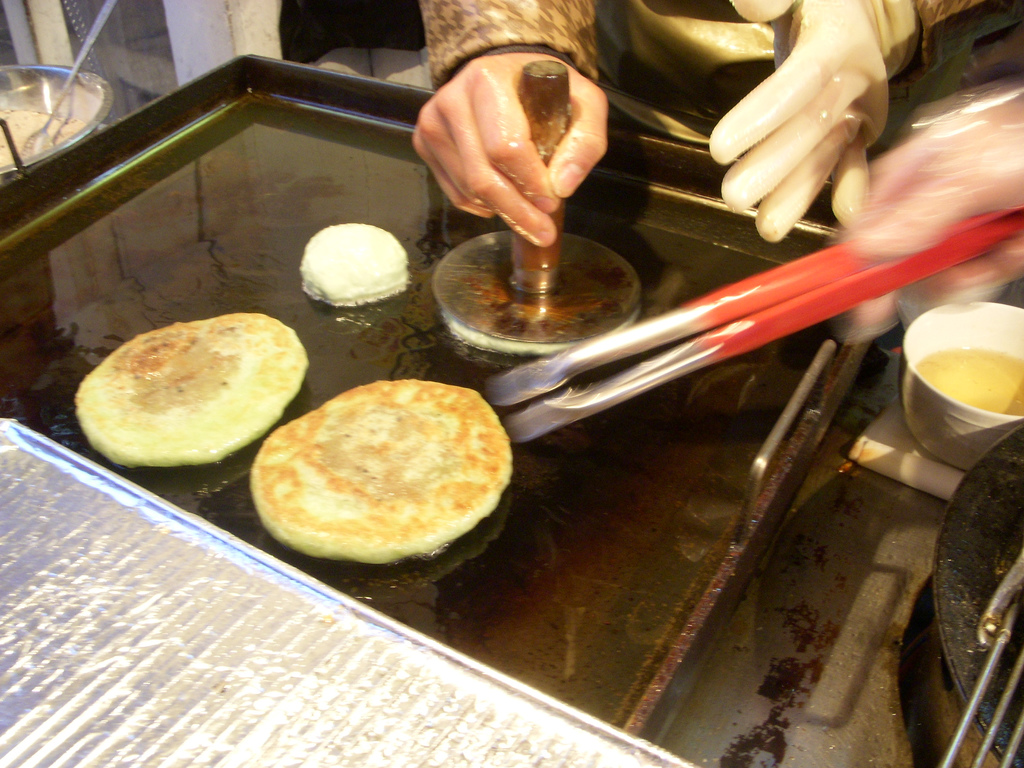 A vendor pressing hotteok flat. Photo: yearofeats / Wikimedia Commons, CC BY 2.0 |
 Ssiat hotteok stuffed with seeds and nuts. Photo: seul5167 / Wikimedia Commons, CC0 1.0 |


Busan's seed version
Ssiat hotteok (씨앗호떡) is the Busan specialty. The fried pancake is cut open and stuffed with a mix of seeds and nuts, then handed over in a paper cup. VisitKorea lists it among the snacks to try at Busan's Bupyeong (Kkangtong) Market. A hotteok typically costs around 2,000 won in Seoul, according to a December 2025 Seoul Economic Daily report, and a mid-2026 Creatrip market guide quotes 1,500–3,000 won in central areas such as Myeong-dong.
3. Gyeranppang (egg bread)
Gyeranppang (계란빵) is a small, lightly sweet bread baked in an oval mold with a whole egg on top. VisitKorea notes that the yolk can be runny or fully set depending on how long it bakes. It is mostly a winter snack, and CNN included it in its list of the world's 50 best breads. Cheese and pizza-style versions also exist. Myeong-dong is the easiest place for visitors to find it, at roughly 1,500–3,000 won as of October 2026.
 Gyeranppang (egg bread) on a Seoul street griddle. Photo: tragrpx / Wikimedia Commons, CC0 1.0 |
 Gyeranppang baking in its oval molds. Photo: Charles Haynes / Wikimedia Commons, CC BY-SA 2.0 |
 Gyeranppang ready to serve at a stall. Photo: anokarina / Wikimedia Commons, CC BY-SA 2.0 |


4. Eomuk fish cake skewers
How eomuk stalls work
Eomuk (어묵), also called odeng, is a fish cake made from white fish and flour, folded onto skewers and kept warm in a pot of broth. At many stalls you pick a skewer from the pot, eat standing up, and the vendor counts your empty skewers at the end. Sipping the broth from a paper cup is half the appeal on a cold day. Some regions also sell a spicy red version.
 Eomuk skewers simmering in broth. Photo: Choe Kwangmo / Wikimedia Commons, CC0 1.0 |
 Kkochi eomuk served with its broth. Photo: anokarina / Wikimedia Commons, CC BY-SA 2.0 |
 Eomuk and tteokbokki at Bupyeong Market, Busan. Photo: Junho Jung / Wikimedia Commons, CC BY-SA 3.0 |


Why Busan matters
Busan is Korea's largest eomuk producer, and the Eomuk Alley at Bupyeong Kkangtong Market is the classic place to eat it. In Myeong-dong, Creatrip lists skewers at about 1,000–3,000 won depending on size.
5. Roasted sweet potatoes and hoppang
Gun-goguma (군고구마, roasted sweet potatoes) and gunbam (roasted chestnuts) were traditionally cooked over a brazier by street vendors. VisitKorea notes that you can now also find them in convenience stores and subway stations. Hoppang (호빵) is a soft steamed bun, classically filled with sweet red bean paste. VisitKorea notes that convenience stores sell steamed buns (jjinppang) and large dumplings (wangmandu) in the cold months. They are handy late at night or where there are no stalls.
 Gun-goguma roasting on hot stones in Daegu. Photo: Brücke-Osteuropa / Wikimedia Commons, CC0 1.0 |
 A countertop hoppang steamer. Photo: TFurban / Wikimedia Commons, CC BY-SA 2.0 |
 Hoppang, a soft steamed bun. Photo: National Institute of Korean Language / Wikimedia Commons, CC BY-SA 2.0 kr |


6. Price guide as of October 2026
Prices vary by stall, neighborhood and filling. The ranges below come from the sources linked at the end; treat them as a rough guide.
| Snack | What it is | Typical price (as of October 2026) | Where to find it |
|---|---|---|---|
| Bungeoppang | Fish-shaped pastry, red bean or custard | About 1,000–1,500 won each in central Seoul | Street stalls, markets; frozen packs in supermarkets |
| Hotteok | Griddled pancake with brown sugar syrup | About 1,500–3,000 won | Markets, Myeong-dong, Jeju Dongmun Market |
| Ssiat hotteok | Hotteok stuffed with seeds and nuts | Varies by stall; ask first | Busan's Bupyeong Kkangtong Market |
| Gyeranppang | Sweet bread with a whole egg | About 1,500–3,000 won in Myeong-dong | Myeong-dong, subway-exit stalls |
| Eomuk | Fish cake skewer in broth | About 1,000–3,000 won per skewer | Street stalls everywhere; Busan's Eomuk Alley |
| Gun-goguma and hoppang | Roasted sweet potato; steamed bun | Varies; check the label or ask | Street braziers, convenience stores, subway stations |
Frozen options are cheaper. The JoongAng Daily reported that a CJ Bibigo frozen bungeoppang pack of 11–12 pieces cost 7,600 won (about 630 won each), and some 7-Eleven branches sell freshly baked ones.
7. Where to find the best stalls
 Food stalls at Gwangjang Market, Seoul. Photo: kallerna / Wikimedia Commons, CC BY-SA 4.0 |
 Bupyeong Kkangtong Night Market, Busan. Photo: Christophe95 / Wikimedia Commons, CC BY-SA 4.0 |
 Entrance to Jeju Dongmun Traditional Market. Photo: Grapesurgeon / Wikimedia Commons, CC BY-SA 4.0 |


Seoul
VisitKorea names three Seoul areas as the "big three" for bungeoppang: around Namyeong-dong, near Hyochang Park, and around Gwangjang Market (88 Changgyeonggung-ro, Jongno-gu). Mangwon Market in Mapo-gu is a well-known hotteok stop. In Myeong-dong, the food carts usually start setting up around 16:00, are busiest from about 18:00 to 21:00 and wind down by about 23:00, according to Creatrip. VisitKorea also points to the food streets near Myeong-dong Station (Line 4, Exit 6) and Hongik University Station (Exit 9).
Busan and Jeju
Busan's Bupyeong (Kkangtong) Market, near Jagalchi Station, is listed by VisitKorea as open 08:00–20:00, with a night market from 19:30 to 23:30 (hours vary by stall). In Jeju City, Dongmun Traditional Market has a whole alley of hotteok stalls; the market itself is open year-round from 08:00 to 21:00.
Pair a snack crawl with kimjang, Korea's kimchi-making season, then warm up with a first visit to a jjimjilbang.
8. How to find and order, step by step
- Look near transit and markets. Stalls cluster at subway exits, bus stops and market entrances, mostly from late afternoon. Searching a map app for 붕어빵 or 호떡 can help.
- Check the sign. Most stalls post a handwritten price, often per piece or as a bundle such as "3개 2,000원" (three for 2,000 won). Many registered vendors in Myeong-dong display prices, and Jongno-gu now requires street vendors around Gwangjang Market to show prices and quantities.
- Have cash ready. Bring 1,000 and 5,000 won bills. Some stalls accept cards, but many still prefer cash.
- Order simply. Point and say the item and number: "Bungeoppang se gae juseyo" (three bungeoppang, please). For fillings, say "patt" (red bean) or "syukeurim" (custard).
- Confirm the total if anything is unclear. "Eolmayeyo?" means "How much is it?" If a price seems wrong, our guide to avoiding overcharging in Korea explains how to report it.
- Eat nearby and return the trash. Public bins are scarce in Myeong-dong; vendors usually take back cups and skewers.
FAQ
When is Korean winter street food season?
From late autumn through winter. Some shops now sell bungeoppang all year.
Is Korean winter street food safe to eat?
Generally, yes. Most of it is cooked to order or kept hot. Choose busy stalls with quick turnover. If you have allergies, note that many snacks contain wheat, eggs, nuts, seeds or fish.
Can I pay by card at street stalls?
Sometimes. Many Myeong-dong vendors take cards, but small stalls often prefer cash.
Are there vegetarian options?
Bungeoppang, hotteok and roasted sweet potatoes usually contain no meat, and gyeranppang suits egg-eating vegetarians. Eomuk is fish-based.
Final thoughts
Korean winter snacks cost a few thousand won and make a cold day far better. Start with a bungeoppang near a subway exit, try a hotteok at a market, and finish with an eomuk skewer and broth. Carry small bills and check the price sign. For help on the go, call the 1330 Korea Travel Helpline (+82-2-1330).
Sources
- Herald Business, bungeoppang season and ingredient price report (Korean, October 10, 2026)
- Korea JoongAng Daily, As 'bung-flation' puts Korea's iconic winter pastry beyond reach, consumers turn to alternatives (December 10, 2025)
- Seoul Economic Daily, Koreans turn to DIY winter snacks as street food prices soar (December 18, 2025)
- VisitKorea, Why Do Koreans Hunt Down Streets in the Middle of Winter? For the K-Snacks! (December 10, 2025)
- VisitKorea, Winter Street Food Battle
- VisitKorea, Fish-Shaped Bun (Bungeoppang) and Egg Muffin (Gyeranppang)
- Creatrip, Seoul Street Food Markets: Where to Eat in Myeongdong, Namdaemun, Gwangjang and Tongin (2026)
Prices, opening hours and phone numbers as published by the sources above, as of October 2026. Stall prices change often and vary by vendor, so check the sign before you order.
Related posts
- Kimjang Season in Korea: How Winter Kimchi Is Made and Where Visitors Can Join in 2026
- How to Use a Jjimjilbang in Korea: First-Visit Steps, Real Prices, Etiquette and Sauna Safety
- Overcharged in Korea? Fair Taxi Fares, Common Tourist Traps and How to Report Them in 2026
By the Korea Vibe Hopper team · Updated October 23, 2026